
Gramateca: Reading food: annotation categories
Comida e bebida, Gramateca, Linguateca
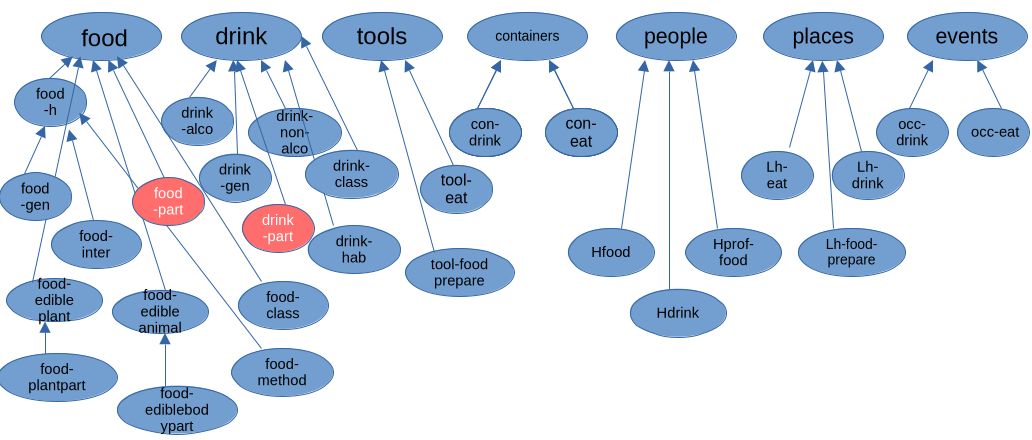
food-gen
Different ways to describe something eatable, without explaining what. Sometimes with an associated connotation (like good food or bad food). Also used to describe a regime (diet). The most obvious word is "food" itself.
food-h
Human food, describes anything that has been prepared or cooked for human consumption. Names of recipes or types of recipes. Examples are cheese, jam, cake or sausage.
food-intermediate
Describes anything that is used for cooking or for creating edible materials, but which is not eaten alone. Examples are butter, sugar, salt, honey and flour. One might have used the word "ingredient" instead.
food-edibleplant
All vegetable names which are eaten, cooked or raw. Such as lettuce, spinach, cinammon, rice or apple.
food-plantpart
A part of a vegetable that is eaten. Such as segment or bud.
food-edibleanimal
All animal names that are edible. Such as herring, duck, chicken or oyster.
food-ediblebodypart
Parts of an animal body which are edible, like head, wings or feet. Also ways of cutting flesh (usually bovine) are included, like tenderloin.
food-part
Word which describe parts/quantities of food. For example, loaf or slice.
drink-part
Words to describe instances/quantities of drink. Words like sip and pint.
food-meth
Food that is described by their cooking method, such as brew, charcoal, or roast. Also "papa" (which describes consistency), soup and purée.
food-class
This category includes general categories in which several items are classified, such as fish, meat, dessert, cereals. It is more specific than food-gen, but less specific than food-h.
con-food
Containers for food, both for preparing, storing, carrying and serving. So things like frying pan, plate, or bowl.
con-drink
Containers for drinkables, both for preparing, storing, carrying and serving. Things like bottle, kettle, jar, cup or barrel.
tool-foodprepare
Instruments for preparing food (in addition to containers), such as dough roller.
tool-eat
Instruments used for eating, such as spoon, or fork.
Hprof-food
(Human) professions related to food (and drink), such as cook, sommelier or baker.
Hfood
Human characterization related to food, such as glutton.
Hdrink
Human characterization related to drink, such as drunkard.
Lh-foodprepare
Places (in human geography, that is, built by humans) related to food preparation, or storage. Places like bakery or kitchen, but also places where specific parts of food preparing are done or kept, like smokehouse or wine cellar.
Lh-eat
Places (in human geography, that is, built by humans) related to food consumption, such as pastry shop or restaurant.
Lh-drink
Places (in human geography, that is, built by humans) related to drink consumption, such as tavern or bar, or distillery.
drink-non-alco
Non-alcoholic beverages, such as juice or water.
drink-alco
Alcoholic beverages, often brand names, like wine, Port or Champagne.
drink-gen
General description of drinks.
drink-class
Description of a class of drinks, like refreshments.
drink-hab
Drinking as habit. Also marking drunkenness (too much drink).
occ-eat
Names for meals or eating activities, such as dinner, picnic or banquet, or parts of meals, like dessert or coffee. Also for specific names given to eating in special occasions, like marriages or Christmas.
jfood
Adjectives related to food or drink, such as tasty, ripe, nutritive, tender or rancid.
Last update: 26 September 2026.
Contact Linguateca's corpus-based grammar team.